
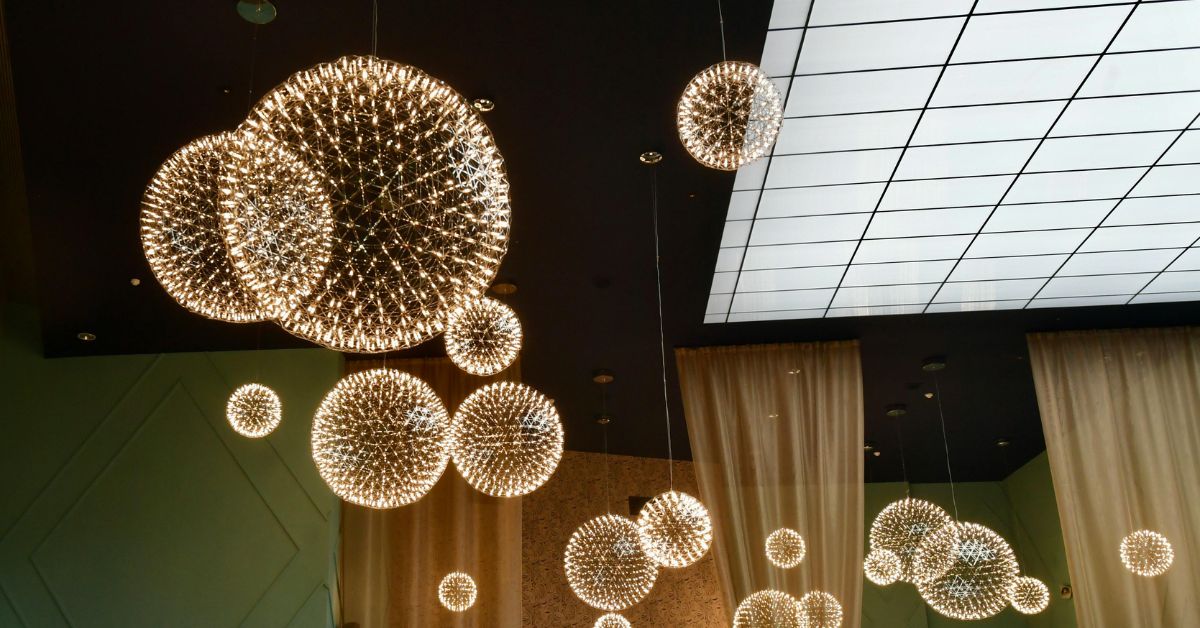
LED ceiling lights provide efficient, uniform illumination for homes, offices, and commercial spaces. This guide explains types (recessed panels, downlights, surface-mounted, decorative), technical specs (lumens, CCT, CRI, PF), Delhi-specific buying tips (dust, heat, surge protection), installation basics, maintenance, warranty, and a buyer checklist so you can pick the right fixtures without extra research.
1. Why LED ceiling lights matter in Delhi
LED ceiling lights are the backbone of modern interior lighting — they deliver energy-efficient, long-lasting illumination with clean aesthetics and flexible control options. In Delhi, where residential, retail, and office spaces demand both visual comfort and lower electricity bills, choosing the right LED ceiling fixture can enhance ambience, reduce operating costs, and simplify maintenance.
This guide from Agarsain Bath & Lights — The Lantern is a one-stop resource for anyone in Delhi thinking about LED ceiling lights: architects, interior designers, contractors, store owners, and homeowners. You’ll learn the different product types and where each fits best, the technical specs that actually matter (and the ranges to aim for), installation scenarios common in Delhi apartments and commercial fit-outs, maintenance routines to handle dust and heat, and a practical purchasing checklist. No jargon, no fluff — everything a new buyer needs to know to decide and specify confidently.
2. What are LED ceiling lights?
LED ceiling lights are fixtures designed to be mounted on or recessed into a ceiling that use light-emitting diodes (LEDs) as the light source. They range from ultra-slim LED panels and recessed downlights to surface-mounted batten-style fixtures and decorative LED chandeliers. Compared to older fluorescent or incandescent ceiling lights, LEDs offer higher efficiency (more lumens per watt), longer life, instant start, and better dimming and control options.
Key benefits:
- Lower energy consumption and running costs
- Long lifetimes (often 25,000–50,000+ hours depending on quality)
- Slim form factors that fit modern minimalist design
- Better control options (DALI, 0–10V, smart home systems)
- Reduced maintenance and fewer lamp replacements
3. Types of LED ceiling lights & best uses
Recessed LED Downlights (cans / COB downlights)
- Installed into ceiling cavities for a clean, integrated look. Common in living rooms, hallways, and offices. Use for focused task light or general ambient lighting, depending on beam angle and spacing.
LED Panel Lights (flat panels)
- Slim, even panels (usually 600×600 mm or 300×1200 mm) are used in suspended tile ceilings (offices) and modern homes. Provide wide-area uniform illumination and replace old fluorescent troffers.
Surface-mounted LED Ceiling Lights (bulkheads/batten style/round/oval panels)
- Mounted directly onto the ceiling when recessed installation isn’t possible. Good for apartments with shallow ceilings or for budget retrofit projects.
LED Linear Ceiling Lights
- Long, slim linear fixtures — suspended or surface-mounted — used for corridors, kitchens, classrooms, and retail aisles. Provide continuous, even runs of light.
LED Downlight + Trimless Slot Combinations
- Integrated solutions for designer ceilings where slots, coves, and accent lighting are combined with downlights for layered lighting.
Decorative LED Ceiling Fixtures (chandeliers, flush-mount designer panels)
- Combine aesthetics with light; used in foyers, hotels, restaurants, and residential living spaces. Often dimmable and available in tunable-white or RGB options.
High-bay/Low-bay LED Ceiling Lights
- For industrial/warehouse/large retail spaces. High lumen outputs and specific optics for uniform floor illumination.
Emergency LED Ceiling Lights & Integrated Exit Fixtures
- Required for many commercial buildings for safety compliance — often combined with ceiling fixtures or as separate units.
Where to use each:
- Homes: recessed downlights, panels, decorative fixtures.
- Offices: LED panels (600×600) and linear fixtures with good glare control.
- Retail: a mix of recessed accent downlights and linear for aisles. High CRI for product display.
- Corridors/stairwells: surface-mounted or recessed uniform fixtures.
- Warehouses: high-bay LED fixtures with high lumen output.
4. Technical specs explained — what buyers actually need to check
Lumen output (lm) & lumens per fixture
- What: Total light emitted. Don’t choose lamps by watts alone — watts tell power draw, lumens tell brightness.
- Practical: For general ambient lighting, target 300–500 lumens per square metre (lux) depending on use (see lux table later). For individual fixtures, manufacturers list lumens per fixture; use those to calculate the required quantity.
Efficacy (lm/W)
- What: Lumens produced per watt consumed. Higher efficacy = better energy efficiency.
- Recommendation: Aim for ≥100 lm/W for good modern fixtures. Premium products can exceed 120–140 lm/W.
CCT — Correlated Colour Temperature (Kelvin, K)
- What: Perceived warmth or coolness of the light.
- Guidance:
- Warm residential: 2,700–3,300K (cozy, relaxing)
- Neutral/office: 3,300–4,000K (daylight-neutral, alert)
- Retail/Task: 3,500–5,000K depending on product and ambience.
- Tip: Use tunable white (2700–6500K) in spaces that need flexible ambience.
CRI — Colour Rendering Index
- What: How accurately colours appear under the light.
- Recommendation: CRI ≥80 for general use; CRI ≥90 for retail, art, and hospitality where colour fidelity matters.
Beam angle/optics
- What: Narrow beams for accenting, wide beams for general lighting. Downlight beam angles are commonly 15°, 24°, 38°, etc. Panels usually have a wide spread. Choose based on ceiling height and purpose.
Power factor (PF) & THD (electrical quality)
- What: PF close to 1 reduces reactive power; THD indicates waveform distortion.
- Recommendation: PF > 0.9 and THD < 20% for stable and power-system-friendly fixtures.
Dimming & controls
- What: Check driver compatibility: TRIAC (leading-edge), 0–10V, DALI/DALI-2, DMX, or smart protocols (Zigbee/Wi-Fi).
- Recommendation: For commercial projects, use DALI/DALI-2 for robust, centralized control. For homes, choose a driver compatible with your dimmer brand.
Driver type & location
- Onboard vs remote drivers. Remote drivers reduce heat inside small fixtures and simplify maintenance. For long ceiling runs, remote drivers are easier to service.
Lifetime & LM figures
- Look for LM-80 test data and lifetime ratings like L70 @ 50,000 hrs (meaning lumen output will be 70% of original after 50,000 hours). Prefer L70 ≥ 50,000 hrs for long-term value.
IP rating (Ingress Protection)
- What: Dust/water resistance.
- Recommendation: Indoor ceiling fixtures typically IP20 rating; bathrooms, kitchens, or external soffits need an IP44 or higher rating. Outdoor ceiling fixtures should be IP65+.
IK rating (Impact resistance)
- For public or high-traffic areas, IK ratings indicate resistance to impact (e.g., IK08).
Materials & finishes
- Aluminium housings with powder coat or anodized finishes, polycarbonate or PMMA diffusers. For humid areas, choose corrosion-resistant finishes.
Certifications & safety
- Ask for BIS/CE/RoHS where applicable, and for driver certifications. For commercial installations, ensure compliance with local electrical codes.
Thermal management
- LEDs need heat sinking. Poor thermal design shortens life and causes colour shifts. Choose fixtures with well-designed aluminum bodies and good ventilation or remote drivers in enclosed cavities.
Surge protection
- Delhi’s electrical supply can have spikes. For reliability, ask for drivers with built-in surge protection or fit external surge protection devices at distribution boards.
5. Design & application use-cases — lux targets and layout tips
Typical lux (illuminance) targets
- Living rooms (ambient): 100–200 lux
- Kitchens (task): 300–500 lux
- Bedrooms: 100–200 lux (higher for reading zones)
- Offices (general): 300–500 lux at desk level
- Retail (product display): 300–700 lux, depending on product
- Corridors/stairwells: 100–200 lux
- Bathrooms: 200–300 lux (task at mirrors higher)
Spacing & layout basics
- Recessed downlights: use spacing roughly equal to ceiling height for even distribution (e.g., 2.7 m ceiling → ~2.7 m spacing) — adjust based on beam angle and required lux.
- Panels: Use a grid layout to avoid dark spots; 600×600 panels are commonly spaced in a suspended ceiling grid.
- Linear lights: run parallel to work surfaces for glare control and uniformity.
- Layer lighting: combine ambient ceiling lights with task lights (under-cabinet, pendants) and accent lights for depth and flexibility.
Glare control
- Use baffles, recessed trims, or downlight anti-glare options for screens and seating areas. Choose diffusers that provide uniform output without hotspots.
6. Buying guide for Delhi — practical local considerations
Climate & dust: Delhi’s hot summers and dusty conditions mean fixtures in exposed ceiling cavities can accumulate dust — choose sealed diffusers and easy-to-clean surfaces. For semi-exposed areas (balconies, external soffits), select appropriate IP ratings.
Electrical stability: Use drivers with wide input voltage tolerance and surge protection; prefer brands offering surge-tolerant drivers. For large projects, specify harmonic and PF requirements to avoid issues.
Local support & spares: Buy from suppliers with local showrooms and after-sales service — this reduces downtime and simplifies warranty claims. Keep spare drivers and a few spare fixtures for long runs.
Controls & future-proofing: For commercial buildings, plan for DALI/DALI-2 or smart building integration. For homes, check compatibility with home automation systems (Google Home, Alexa) if desired.
Budget buckets:
- Economy: basic LED panels and downlights with lower CRI and basic drivers — low upfront cost, mixed long-term value.
- Mid-range: better binning, PF >0.9, CRI 80–90, dimmable drivers. Best value for most projects.
- Premium: high CRI ≥90, tunable white, DALI-2, longer warranties, photometric reports, and better thermal design.
Samples & mockups: Always request a sample or mockup run — colour and glare are often different in real spaces than in photos.
Where to buy: Agarsain Bath & Lights (The Lantern) showrooms, authorized dealers, or direct project sales. Ask for IES files and product datasheets before ordering.
7. Installation & wiring basics
Recessed downlights/panels:
- Ensure ceiling void depth and insulation compatibility. Use proper cut-out templates, support frames for heavy panels, route driver access, and allow space for driver servicing. For trimless installations, coordinate with plaster and paint contractors.
Surface-mounted fixtures:
- Mount to solid substrate, ensure correct anchors for heavy decorative fixtures, conceal wiring in conduits per code, and use junction boxes where required.
Dimming & control wiring:
- Separate control wiring for DALI/0–10V networks from mains where recommended. Label circuits clearly and map drivers to control addresses during commissioning.
EMC & earthing:
- Ensure proper earthing and cable sizing. Keep LED drivers away from strong electromagnetic sources to avoid flicker or interference.
Certified electricians & commissioning:
- Use licensed electricians and perform commissioning tests: lux readings, dimming smoothness, power factor checks, and thermal checks for drivers.
8. Maintenance, cleaning & troubleshooting
Cleaning: In Delhi, dust builds up quickly. Monthly dusting of diffusers and quarterly wipe-downs with a damp cloth and mild detergent are recommended. Avoid abrasives.
Routine checks: Annual inspection of drivers for heat buildup, discoloration, or buzzing. Check connections and look for flicker or dimming irregularities.
Troubleshooting:
- Flicker: likely driver or dimmer incompatibility. Test with a known-good driver.
- Colour inconsistency: could be mixed LED bins or aged LEDs — replace in matched batches.
- Reduced light output: check for dirty diffusers or heat-induced lumen depreciation.
Spare parts & labeling: Keep spare drivers, a couple of fixture units, and maintain an installation map showing driver locations and fixture serials for quick servicing.
Warranty claims: Keep invoices, photos, installation dates, and serial numbers. Agarsain provides warranty support — check the exact warranty terms per product.
9. FAQs — quick answers buyers need
Q1: What’s better — recessed downlights or LED panels?
A: Panels give wide, uniform illumination ideal for offices. Downlights are more flexible for layered lighting and accents. Choose based on ceiling type and design intent.
Q2: How to choose CCT for my home in Delhi?
A: Use warm (2,700–3,300K) in living and bedrooms; neutral (3,300–4,000K) for kitchens and work areas. Consider tunable white for flexibility.
Q3: What CRI do I need?
A: CRI ≥80 for most rooms; CRI ≥90 for retail, art, textiles, and hospitality.
Q4: Can LED ceiling lights be dimmed?
A: Yes — ensure fixture driver supports your dimming system (TRIAC, DALI, 0–10V) and that dimmer compatibility is confirmed.
Q5: How long do LED ceiling lights last?
A: Quality fixtures often claim 50,000+ hours (L70), but driver quality and thermal design affect real life.
Q6: Are LED panels better than fluorescent troffers?
A: Yes — LEDs are more efficient, have instant start, less flicker, and lower maintenance.
Q7: What maintenance do they need?
A: Periodic dusting, annual driver check, and keeping spares for long runs.
Q8: Should I get a sample before ordering?
A: Absolutely — a 1–2 sample mockup helps verify colour, glare, and uniformity.
10. Conclusion & Call to Action
LED ceiling lights are a practical, energy-efficient way to modernize lighting in Delhi homes and commercial spaces. Prioritize lumen output, CRI, driver quality, and proper thermal design — and always test samples onsite. Ready to specify LED ceiling lights for your project? Visit Agarsain Bath & Lights (The Lantern) for product samples, IES files, custom layouts, and expert lighting consultations — or request an on-site demo and quotation today.