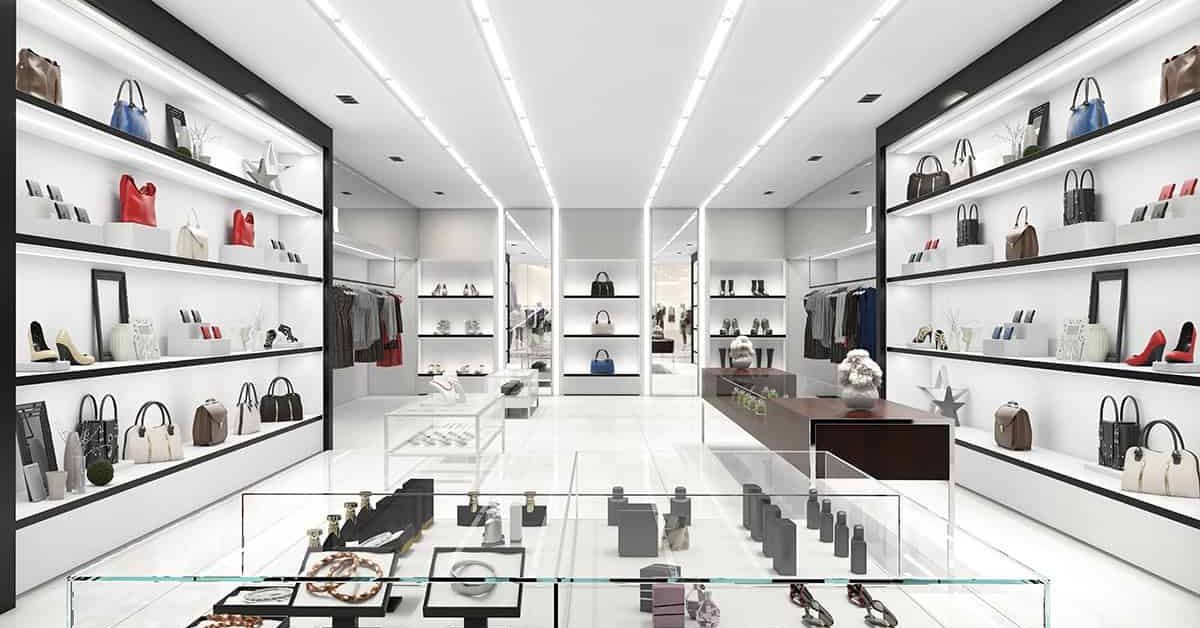
If you’re asking how to light a retail store, you want a space that makes products pop, guides customers, and spends as little on power and maintenance as possible. This guide walks a new buyer step-by-step through the whole process: strategy, measurable targets, product specs to demand, fixture choices, control systems, installation advice, commissioning, and procurement language you can copy and paste. It’s written to be practical and product-oriented so you can brief suppliers and electricians with confidence.
Throughout, I’ll show exact numbers and example calculations (done step-by-step), so you won’t guess at the results. Read this, and you’ll know precisely how to light a retail store that sells more while costing less to run.
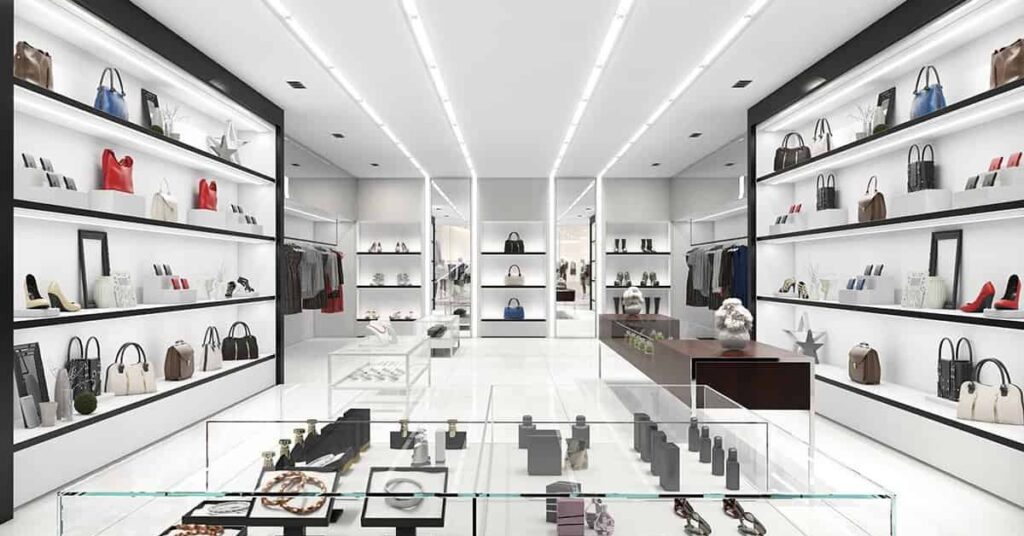
Quick overview — what matters most when you learn how to light a retail store
- Zoning: split the store into ambient, accent, task, window, and display zones.
- Targets: set lux targets per zone (product plane) and use lumens, not watts.
- Colour: select CCT and CRI to suit your merchandise.
- Optics: choose beam angles for even coverage and controlled highlights.
- Controls: use zoning, scenes, and daylight harvesting to cut energy use.
- Procurement: demand lm/W, CCT, CRI, L70, flicker data, and IES files.
- Commissioning: measure on-site lux and fine-tune aims and scenes.
If you remember these seven things, you’ll already be well on your way to understanding how to light a retail store correctly.
Step 1 — Define your retail lighting strategy (before you buy anything)
Before picking fixtures, answer these questions:
- What is the store’s primary function? (Fashion, grocery, jewellery, electronics, furniture.)
- Which zones are critical for sales (window, feature wall, point-of-sale)?
- Do you want a dramatic, theatrical look or a bright, clinical display?
- How many hours per day will lighting be on? (This affects economics.)
- Is the space single-storey or double-height? (Scale changes fixture choice.)
Example: a boutique selling textiles prioritizes warm, flattering light (CCT ~3000K, CRI ≥90) and dramatic window displays; a hardware store needs crisp, neutral 4000K light to show finish and detail.
Answering the above is the first practical step in learning how to light a retail store.
Step 2 — Zone, lux targets, and lumen math (do the numbers repeatably)
Zoning is the foundation. Typical retail zones and recommended lux (illuminance at the product plane):
- Window display & feature: 800–2,000 lx (highly visual)
- Merchandise/feature shelves: 500–1,000 lx
- General sales floor (ambient): 300–600 lx, depending on product type
- Fitting rooms: 300–500 lx with vertical illumination for flattering mirrors
- Checkout/point-of-sale: 300–600 lx
- Back-of-house: 100–300 lx (task dependent)
How to convert lux to lumens (one repeatable calculation used when you learn how to light a retail store):
- Measure the zone area (A) in m².
- Choose target lux (L) from the list above.
- Multiply: required lumens on plane = A × L.
- Divide by a maintenance factor (MF ≈ 0.7) to account for fixture losses and dirt.
- The result is the installed lumens target.
Worked example (step-by-step digits): you want 500 lx on a feature wall that is 4.0 m wide and 2.5 m high — area A = 4.0 × 2.5.
- Compute A: 4.0 × 2.5 = (4 × 25) ÷ 10 = 100 ÷ 10 = 10.0 m².
- Required lumens on plane = A × L = 10.0 × 500. Do the arithmetic: 10 × 500 = 5,000 lm.
- Installed lumens = 5,000 ÷ 0.7. Compute: 5,000 × (10/7) = 50,000 ÷ 7. Long division: 7 × 7,142 = 49,994 remainder 6 → ≈ 7,142.86 lm. Round to ≈7,143 lm installed.
- If you plan to use 6 track spots on that wall, each spot should deliver approximately 7,143 ÷ 6 = do division: 7143 ÷ 6 = 1,190 remainder 3 → ≈1,190 lm per spot delivered.
This arithmetic lets you size fixtures and is central to how to light a retail store with measurable outcomes.
Step 3 — Choose CCT & CRI carefully (merchandise specifics)
Colour makes or breaks retail. Guidelines:
- Clothing/fashion/textiles: CCT 3,000–3,300K, CRI ≥ 90. Warmer tone flatters skin and fabrics.
- Jewellery: CCT 2,700–3,000K for warmth, plus very high CRI ≥ 95 and tight beam control.
- Food/produce: CCT 3,000–3,500K, CRI ≥ 90 to keep produce looking fresh.
- Electronics/hardware: CCT 3,500–4,000K, CRI ≥ 80–90 for detail clarity.
- Furniture/home décor: use tunable white (2,700–4,000K) to test products across moods.
When you write procurement docs, include exact CCT and CRI numbers for each zone — this is non-negotiable when learning how to light a retail store professionally.
Step 4 — Optics & beam angles (control light, avoid wasted spill)
Beam angle choice controls how light concentrates and how many fixtures you need:
- Narrow beams (10°–24°): tight spots — jewellery or a single mannequin.
- Medium beams (24°–40°): general accent for product walls and small displays.
- Wide beams (40°–60°+): ambient fixtures or wide shelf washes.
Rule of thumb for accent spacing: aim distance roughly equals 1–1.5× the beam diameter on the target plane. Use photometrics (IES files) for precision.
Beam control is a core skill in how to light a retail store — good optics mean fewer fixtures and crisper merchandising.
Step 5 — Fixture types and where to use them (practical product guidance)
Pick fixtures based on function:
- Track lighting (adjustable heads): flexible accenting, easy to re-aim when displays change — great for most shops.
- Suspended linear LEDs: excellent for uniform ambient lighting and modern brand language.
- Recessed downlights with low-glare trims: clean ambient lighting with a hidden source.
- Spotlights / micro-lenses: use for high-CRI product highlights (jewellery, watches).
- LED strips & shelf washers: even illumination for shelving runs, good for supermarkets and stores with long gondolas.
- Display case lighting: micro-spots or miniature linear with high CRI.
- Decorative pendants: brand-defining pieces; use them as focal accents rather than primary light sources.
When considering how to light a retail store, choose fixtures offering replaceable drivers and compatible beam accessories (lenses, snoots) to extend flexibility.
Step 6 — Controls: zoning, scenes, and protocols
Controls are where energy savings and merchandising flexibility happen. Key control ideas to include in your plan:
- Zoning: group fixtures by function (window, feature wall, aisles, checkout).
- Scenes: pre-programmed scenes for open, sale, evening, cleaning, and sampling events.
- Dimming & tunable white: use for mood and to shift CCT across the day.
- Daylight harvesting: Reduce electric light where daylight is available.
- Occupancy controls: back-of-house and storage to save energy.
- Protocols: prefer DALI-2 for addressable, professional lighting control; use Zigbee/Thread mesh for smart retail subsets; avoid Wi-Fi bulbs for core merchandising lighting.
If you’re specifying controls, demand a central management interface, remote diagnostics, and power metering per zone. This is advanced practice in how to light a retail store and pays off at scale.
Step 7 — Energy, efficacy & lifecycle economics (real numbers)
Pick fixtures by efficacy (lm/W) and consider L70 life and warranty. Quick calculation example to show savings (stepwise digits):
Scenario: replacing 20 halogen 50 W spots with 8 W LED equivalents (same light).
- Power saved per fixture = 50 W − 8 W = 42 W = 0.042 kW.
- Annual hours assumed = 12 hours/day × 365 = compute: 12 × 300 = 3,600; 12 × 60 = 720; 12 × 5 = 60; sum = 3,600 + 720 + 60 = 4,380 hours.
- Annual kWh saved per fixture = 0.042 × 4,380 = compute: 0.040 × 4,380 = 175.2; 0.002 × 4,380 = 8.76; sum = 175.2 + 8.76 = 183.96 kWh.
- For 20 fixtures: 183.96 × 20 = compute 183.96 × 2 = 367.92 then ×10 = 3,679.2 kWh saved annually.
- At electricity ₹10/kWh → monetary saving = 3,679.2 × 10 = ₹36,792 per year.
This shows why knowing how to light a retail store with efficient LED fixtures is often a top operational priority.
Step 8 — Procurement: specs to demand & RFQ template
When inviting quotes, demand measurements, not claims. Minimum spec list:
- Delivered lumens (lm) and efficacy (lm/W).
- Beam angle and IES photometric files.
- CCT (Kelvin) and CRI value.
- L70 hours and the manufacturer’s warranty.
- Flicker % and dimming protocol compatibility.
- Driver replaceability, IP rating, and mounting hardware.
- DALI or control compatibility and commissioning included.
Copy-paste RFQ snippet (edit zone/quantities):
RFQ: Supply & install feature wall lighting — 6 × track spot heads, delivered lumens 1,200 lm per head, beam 24°, CCT 3,000K, CRI ≥ 92, dimmable (DALI & triac), flicker <5% (report required), driver accessible in ceiling void; include IES files, controls (DALI panel), site commissioning, and 5-year warranty.
Use this when you’re serious about learning how to light a retail store correctly — it forces vendors to provide hard data.
Step 9 — Installation, aiming, and commissioning (on-site work)
Good installation and commissioning are essential.
- Pre-installation mock-up: install a section (window + one merch wall) to verify looks with real merchandise.
- Run control wiring and mount tracks before finishing to avoid rework.
- Aim and tune: measure lux at product planes with a calibrated meter, then re-aim spotlights to meet targets.
- Program scenes for opening, peak, evening, and events.
- Record and handover: as-built IES, wiring diagram, fixture serials, dimmer lists, and control credentials.
If you want to know how to light a retail store that performs, don’t skip on-site commissioning and signed acceptance.
Step 10 — Maintenance and spares plan
Plan for maintenance to keep the lighting effective:
- Keep spare drivers and common lamp modules on site.
- Quarterly cleaning of lenses and windows — dust and fingerprints reduce output.
- Annual re-aiming check after seasonal display changes.
- Remote monitoring alerts for failures if controls support it.
A simple spare parts kit and logbook are among the most cost-effective shop lighting ideas you can implement.
Common pitfalls when you learn how to light a retail store (and how to avoid them)
- Buying by watts, not lumens — always buy by delivered lumens.
- Ignoring CRI — low CRI kills colour-rich products.
- No mock-up — the showroom photo will mislead you. Test in-situ.
- Poor driver access — requires replaceable drivers.
- Skipping controls — you’ll waste energy and miss merchandising flexibility.
Avoid these, and your lighting plan will be both beautiful and durable.
Quick checklist — before you sign a supplier contract
- Lux & lumens targets documented per zone.
- IES photometrics requested and reviewed.
- CCT & CRI are specified for each product category.
- DALI/controls scope included and commissioning clarified.
- Driver replaceability & warranty confirmed.
- On-site mock-up and commissioning included in price.
- Spare parts and maintenance plan confirmed.
Checking these boxes ensures you’ll know how to light a retail store the professional way.
Helpful manufacturers & standards (test before buying)
For product datasheets, IES files, and documented compatibility, start with established suppliers and check national efficiency guidance. Example manufacturers and resources to consult include Philips for professional fixtures and photometrics, practical retail options at IKEA, and for energy & compliance guidance, refer to the Bureau of Energy Efficiency, where applicable. For drivers and power supplies, companies like Mean Well publish detailed specs that are useful in procurement.
(Use these as starting points, but always validate data sheets and request test reports.)
Final thoughts — turning strategy into sales
Lighting is the silent salesperson. When you understand how to light a retail store, you design with measurable targets, choose the right fixtures and controls, and commit to commissioning and maintenance. Good lighting increases dwell time, improves perceived product quality, and reduces operational costs. Use the zoning, math, product specs, and RFQ templates above, and you’ll get a store that looks great, works reliably, and delivers real ROI.