
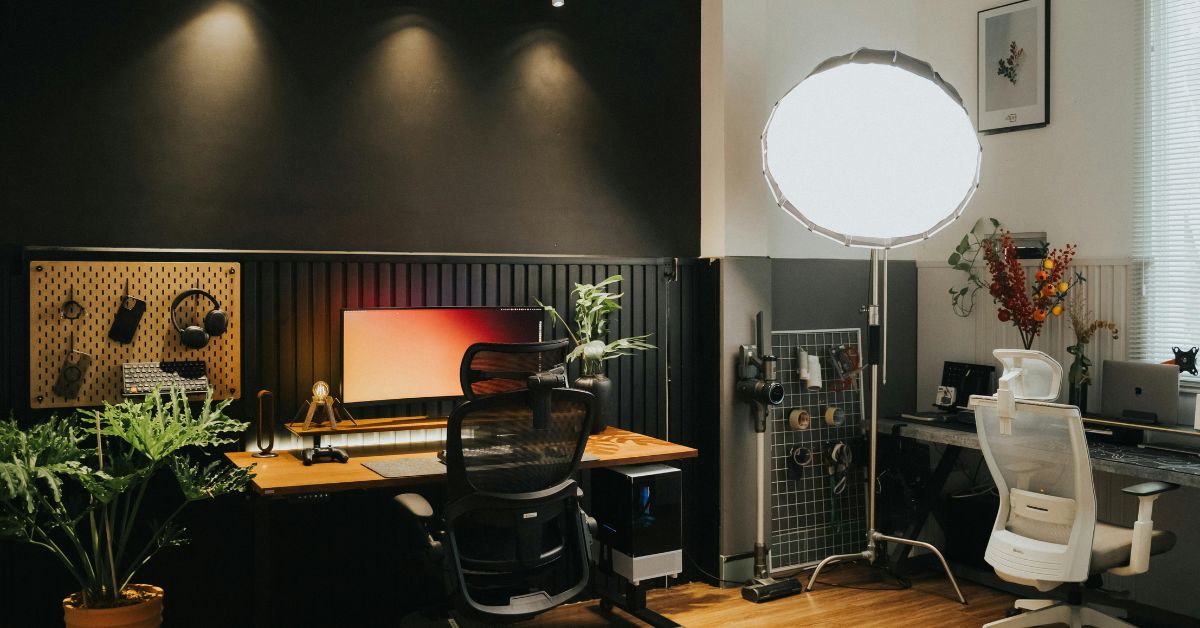
Choosing the right Lighting for Home and Office changes how a space feels and performs. Good lighting reduces eye strain, boosts productivity, enhances décor, and cuts energy bills. This guide is written for buyers who want to make real decisions — not for installers — and covers product specs to demand, room- and task-based recommendations, controls and smart systems, retrofit tips, maintenance, budgeting, and ready-to-use RFQ lines you can paste into emails.
Throughout, I’ll use plain language, practical rules, and product-focused advice so you can shortlist fixtures and get comparable quotes.
Why Lighting for Home and Office Matters
Lighting affects function and mood in both homes and offices:
- In homes, the right light supports relaxation, tasks (cooking, reading), and accentuates décor.
- In offices, the right light improves concentration, reduces errors, and supports health (circadian-friendly lighting can improve alertness during the day).
- Good Lighting for Home and Office balances brightness, color, glare control, and flexibility — and those are measurable properties, not just subjective taste.
If you plan lighting as scenes (ambient + task + accent) and specify the correct numbers, you’ll avoid the most common mistakes: underlit desks, harsh glare on screens, and poor color rendering in kitchens and showrooms.
The core numbers buyers must understand
When comparing fixtures for Lighting for Home and Office, insist on these specs. They’re the only things that reliably predict performance.
- Lumens (lm): total output of a lamp or fixture. Use lumens when comparing brightness.
- Lux (lx): lumens per square metre — the practical light level on a surface. Offices often aim for 300–500 lx at desk level; living rooms 150–300 lx; kitchens 300–500 lx at counters.
- CCT (Correlated Color Temperature): measured in Kelvin (K). Warm = 2700–3000K (home living, bedrooms), neutral = 3500–4000K (balanced tasks), cool = 4000–5000K+ (clinical, high-attention work).
- CRI (Color Rendering Index): 0–100 scale. For kitchens, design studios, and retail displays, choose CRI ≥ 90. Offices can use CRI 80–90.
- Efficacy (lm/W): lumens per watt. Look for higher numbers to save energy — modern LEDs commonly deliver > 90 lm/W.
- UGR / glare & flicker: For office spaces with screens, specify low UGR (<19) and low flicker (<5%) to protect comfort and reduce headaches.
- L70 (rated life) and warranty: ask for L70 ≥ 50,000 hours and at least a 3-year warranty on fixtures and drivers.
Treat these figures as your checklist when getting quotes for Lighting for Home and Office — require them in writing.
Types of fixtures and where to use them
A practical Lighting for Home and Office plan mixes fixture families for layered lighting.
- Recessed downlights: great for clean ambient light; select UGR-rated trims for offices.
- Panels & troffers: efficient for grid ceilings and open-plan offices — choose low-glare diffusers.
- Linear suspended fixtures: ideal for desks, dining tables, and long counters; look for asymmetric optics to reduce screen reflections.
- Track & spotlights: use for flexible accenting in homes, display lighting in retail areas, and focused task lighting in studios.
- Task lamps & under-cabinet strips: essential in kitchens, bedside areas, and home offices — pick CRI 90+ for accurate color.
- Cove & indirect lighting: softens the ceiling, reduces contrast, and works well behind TVs or in lounges.
- Outdoor-rated fixtures: for porches and walkways, use IP65+ luminaires and warm CCT to be welcoming.
Mix these to cover ambient (general), task (focused), and accent (decorative) layers — that’s how you get professional Lighting for Home and Office results.
Room-by-room targets & practical setups
Below are ready-to-use targets and fixture suggestions you can implement or request from a supplier.
Living Room (Home)
- Target lux: 150–300 lx ambient; 300–500 lx for reading areas.
- CCT & CRI: 2700–3000K; CRI ≥ 90 for art and textiles.
- Fixture plan: dimmable recessed downlights + floor/table lamps at reading points + cove/strip for mood. Use the dim-to-warm feature if you want warmer tones as you dim.
Kitchen (Home)
- Target lux: 300–500 lx on counters; 150–300 lx ambient.
- CCT & CRI: 3500–4000K; CRI ≥ 90 for accurate food colors.
- Fixture plan: neutral recessed downlights, under-cabinet strips (high-CRI), pendant over island with clear beam for prep.
Bedroom (Home)
- Target lux: 100–200 lx ambient; 300 lx for bedside reading.
- CCT & CRI: 2700K preferred; CRI 80–90.
- Fixture plan: warm central ambient + bedside adjustable task lamps + soft cove lighting for night scene.
Home Office
- Target lux: 300–500 lx at desk.
- CCT & CRI: 4000K neutral is common; CRI 90 for colour-sensitive work.
- Fixture plan: linear suspended or uniform recessed ambient + desk lamp with adjustable CCT + glare control for screens.
Open-plan Office
- Target lux: 300–500 lx at workstation plane.
- CCT & CRI: 3500–4000K; CRI 80–90.
- Fixture plan: linear suspended luminaires over rows, low-glare diffusers, task lights on adjustable arms for individual control. Use DALI controls for zoning.
Conference Room
- Target lux: 300–500 lx, with dimming capability for AV.
- CCT & CRI: 3500–4000K; CRI 90 for video clarity.
- Fixture plan: even ambient with dimmable downlights, pendants for table focus, and blackout controls for presentations.
These room plans are practical templates — adjust lumens and fixture counts using the lumens-per-room calculation (area × lux ÷ maintenance factor).
Controls, automation & human-centric lighting
Controls turn Lighting for Home and Office into savings and comfort.
- DALI / DALI-2: professional, two-way digital control for offices; supports grouping, addressing, and diagnostics.
- 0–10V: simple analog dimming, common in retrofit scenarios.
- Wireless mesh (Zigbee/Bluetooth/Thread): excellent for smart-home lighting without heavy cabling.
- Occupancy sensors & daylight harvesting: reduce runtime and costs, especially in meeting rooms and perimeter desks.
- Tunable white & circadian scheduling: adjust CCT through the day — cooler light in the morning for alertness, warmer in the evening for winding down.
For homes, choose systems that allow reliable local scheduling (scenes that run without cloud dependency). For offices, push for DALI integration so facility managers can monitor performance and energy.
Retrofit tips: common pitfalls & solutions
Many buyers upgrade existing fixtures to LED — here’s how to avoid mistakes when planning Lighting for Home and Office retrofits.
- Match lumens, not watts. Replace with lumen output and beam angle to keep the same look.
- Check transformer compatibility. MR16 halogen fixtures often have 12V transformers — either use LED lamps rated for that transformer or replace the transformer with an LED driver.
- Dimming compatibility: test one lamp with the existing dimmer. If flicker or buzzing occurs, use LED-compatible dimmers or specified triac-dimmable lamps.
- Thermal management: LEDs need heat sinking; sealed enclosures can shorten life — pick lamps marked for enclosed use or retrofit with vented trims.
- Power factor & THD: for commercial installations, ask for PF > 0.9 and low harmonics to avoid power quality issues.
Following these product-oriented checks keeps retrofits predictable and ensures your Lighting for Home and Office upgrade actually saves energy and maintenance costs.
Energy, cost & payback (practical math)
Here’s a simple illustrative calculation to show the savings you can expect when upgrading to efficient LED fixtures as part of Lighting for Home and Office.
Scenario: Replace 50 × 50W halogen downlights with 50 × 10W LED equivalents. Operating 10 hours/day, electricity ₹10/kWh.
- Power saved per fixture = 40W = 0.04 kW.
- Annual hours = 10 × 365 = 3,650 h.
- Annual kWh saved per fixture = 0.04 × 3,650 = 146 kWh.
- Annual monetary saving per fixture = 146 × ₹10 = ₹1,460.
- For 50 fixtures: ₹73,000/year saved.
- If the extra upfront cost per LED is ₹300, the total extra cost = 50 × 300 = ₹15,000.
- Payback = 15,000 / 73,000 ≈ 0.2 years (roughly 2–3 months).
This simplified example shows how Lighting for Home and Office retrofits often pay for themselves very quickly, especially in commercial settings with long daily operating hours.
Procurement checklist & RFQ-ready language
When you request quotes, get clear, comparable bids by using precise product language.
Must-have fields in every quote:
- Lumen output (lm) and efficacy (lm/W).
- CCT and CRI.
- Dimming protocol and compatible dimmers.
- L70 rated life and warranty.
- Driver/accessibility and spare parts policy.
- Photometric IES files for layouts and lux maps.
Maintenance, troubleshooting & longevity
Good maintenance keeps your lighting system performing and preserves warranties.
- Quarterly: clean diffusers, check for loose connections, test emergency lighting.
- Annually: photometric audit for offices, driver health check, replace filters/gaskets in outdoor fixtures.
- Spare parts: keep spare drivers and common lamp types from the same batch to avoid color mismatch.
- Troubleshooting: flicker → check driver & dimmer compatibility; sudden failures → inspect driver heat and wiring; color shift → replace modules in matched sets.
Document all installations (model numbers, batch numbers, locations) — it speeds warranty claims and maintenance.
Recommended brands & where to try products
For reliable options and showroom testing, start with known manufacturers and retailers — test finishes, beam quality, and dimming in person. Examples include Philips for professional fixtures, IKEA for approachable smart bulb options, and check local energy guidance from the Bureau of Energy Efficiency if you operate in India or are seeking energy incentive programs.
(Visit local showrooms to see real fixtures under realistic scenes before you buy.)
Final checklist before signing any contract
- Are lux targets and IES files provided? (Yes/No)
- Are lumen, CCT, and CRI specified per fixture? (Yes/No)
- Are dimming protocols and compatible dimmer models listed? (Yes/No)
- Are driver accessibility, spares, and warranty covered? (Yes/No)
- Is a commissioning report and photometric verification included? (Yes/No)
Conclusion
Quality Lighting for Home and Office is measurable, repeatable, and highly impactful. Focus on lumens, lux targets, CCT, and CRI; layer ambient, task, and accent light; choose controls that match your use-case (DALI for commercial, reliable local scenes for homes); and demand clear specs, IES files, and warranties from suppliers. With the product-oriented checklists and RFQ language above, you can brief vendors and get accurate, comparable quotes — and end up with lighting that looks great, supports tasks, and saves money over time.