
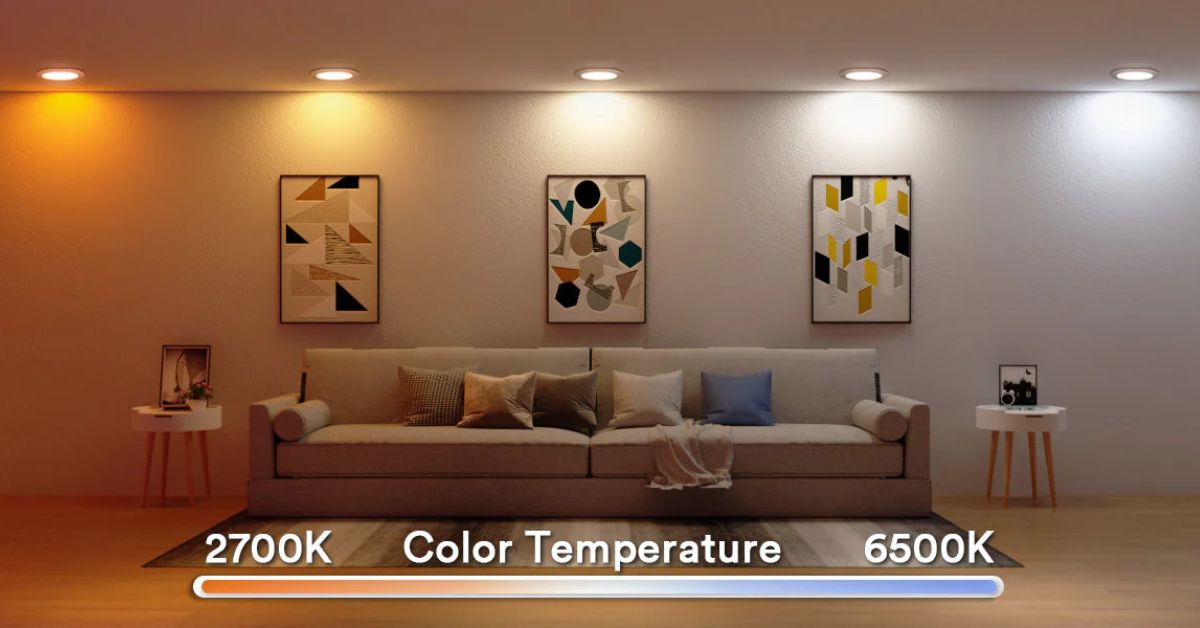
What does “color temperature” mean?
Color temperature is measured in Kelvin (K) and tells you whether a light source looks warm (reddish/yellow), neutral, or cool/blue. Roughly:
- 2200K–2700K — very warm, candlelike glow
- 2700K–3000K — warm white (cozy living rooms, bedrooms)
- 3000K–3500K — warm-neutral (dining, transitional spaces)
- 3500K–4000K — neutral white (kitchens, bathrooms)
- 4000K–5000K+ — cool/daylight (offices, workshops)
Understanding this scale is the starting point for How to Choose the Right Color Temperature for Every Room.
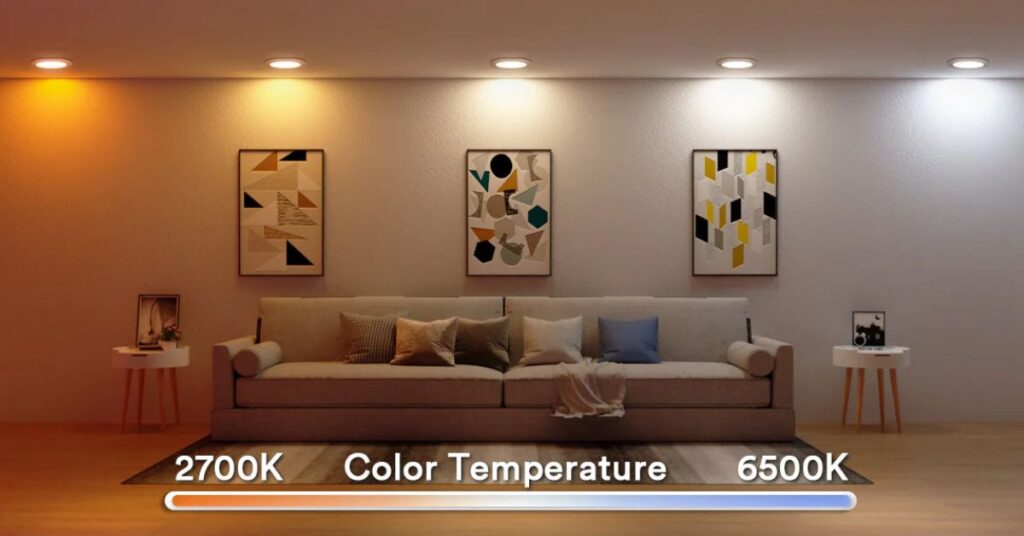
Why color temperature matters (beyond aesthetics)
Color temperature affects:
- Mood & behavior: Cooler light boosts alertness; warmer light promotes relaxation.
- Color perception: The same red fabric can look different under 2700K vs 4000K—so retail, kitchen, and makeup areas need careful choice.
- Task performance: High-contrast tasks benefit from neutral-to-cool CCT.
- Circadian rhythm: Cool, blue-rich light in the evening can delay sleep; warm light supports winding down.
That’s why it helps to plan CCT by room and activity instead of picking a single bulb for the whole house.
How CCT interacts with CRI (color rendering)
CCT is the tone of light; CRI (Color Rendering Index) is the accuracy of color under that light. CRI is measured 0–100 (higher is more accurate). Practical rules:
- General rooms: CRI 80–85 is acceptable.
- Kitchens, bathrooms, closets, retail, art/wardrobe areas: CRI 90+ is highly recommended.
- High color-fidelity needs (textiles, paint sample matching, pro photography): CRI 95+ or better, plus TM-30 data if available.
When you plan, How to Choose the Right Color Temperature for Every Room, always combine your CCT choice with a CRI requirement.
Room-by-room CCT + product guidance
Below are concise, buyer-friendly recommendations, with the practical product attributes to request when you shop.
Living Room
- Target CCT: 2700K–3000K (warm, relaxing)
- Why: Flatters skin tones, creates a cozy atmosphere.
- Product tips: Dim-to-warm downlights or warm-white recessed fixtures, floor/table lamps with adjustable CCT for reading. Specify CRI 90 for good color fidelity in upholstery and art.
Dining Room
- Target CCT: 2700K (intimate) or 3000K (slightly cleaner)
- Why: Warm light enhances food and conversation.
- Product tips: Decorative pendant with dim-to-warm capability; ensure the pendant can be dimmed smoothly to low levels.
Kitchen
- Target CCT: 3500K–4000K (neutral to cool) for prep zones; 3000K for dining nook
- Why: Neutral white improves contrast and reveals food color accurately.
- Product tips: Under-cabinet CRI 90+ strips for counters; neutral ceiling ambient and task pendants as needed.
Bedroom
- Target CCT: 2700K–3000K
- Why: Promotes relaxation and sleep hygiene.
- Product tips: Warm central lighting + bedside tunable lamps (2700–4000K) for morning tasks.
Home Office / Study
- Target CCT: 3500K–5000K, depending on tasks and daylight. 4000K is a safe neutral choice.
- Why: Cooler light boosts alertness and contrast for reading/screens.
- Product tips: Neutral ambient plus a cool task lamp; use CRI 90 for color-critical work.
Bathroom & Vanity
- Target CCT: 3000K–4000K (3500K often optimal)
- Why: Balanced light that flatters skin and supports grooming.
- Product tips: Vanity lighting at face height (CRI 90+), avoid single top-only downlights that cast shadows.
Hallways & Stairs
- Target CCT: 2700K–3000K
- Why: Warm, gentle navigation light; safety first.
- Product tips: Low-glare wall sconces or recessed step lights; occupancy sensors conserve energy.
Outdoor (porch, garden, pathways)
- Target CCT: 2700K–3000K for accenting; 4000K can be used for security lighting
- Why: Warm light reduces insect attraction and looks inviting; cooler light is more clinical and functional.
- Product tips: IP65+ rated fixtures; use warm-white LEDs for landscape and cool white for security poles.
Tunable white — the easiest way to cover uncertainty
If you’re still not sure how to choose the Right Color Temperature for Every Room, choose tunable white fixtures. They allow you to:
- Switch CCT by scene (morning/evening).
- Program circadian schedules (cooler in daytime, warmer at night).
- Avoid long-term regret when you later refine your lighting taste.
Tunable systems are often offered as integrated fixtures or smart bulbs. For long-term performance, integrated tunable fixtures generally offer better optics and longevity than consumer smart bulbs.
Practical Kelvin cheat sheet (poster-ready)
- 2200K — candlelike, romantic
- 2700K — warm, cozy (living room, bedroom)
- 3000K — warm-neutral (dining, hospitality)
- 3500K — balanced (transitional zones)
- 4000K — neutral white (kitchen, bathroom)
- 5000K+ — daylight (workshop, detail tasks)
Use the cheat sheet when you walk into a showroom or fill an RFQ: it removes ambiguity.
How to test color temperature in real life
- Bring real materials: fabric swatches, paint chips, and photos of your furniture.
- Request a sample: get a bulb or a single fixture to trial in the actual room for several evenings.
- Test dimming: test the fixture through its dim range; does the color shift or the fixture buzz?
- Compare batches: if buying multiple fixtures, ensure they’re from the same production run to avoid CCT variation.
Testing in situ is the single best way to decide how to choose the Right Color Temperature for Every Room for your unique materials and tastes.
Layering light with CCT in mind
When you design lighting, think in layers:
- Ambient (general): choose a primary CCT for comfort.
- Task (focused): choose a slightly cooler or neutral CCT for reading, cooking, or working.
- Accent (feature): vary CCT by a small step to enhance texture or color—warmer for wood, slightly cooler for metallics.
Rule of thumb: keep ambient consistent across a zone; vary task and accent purposefully.
Buying checklist — product specs to request
When shopping or asking suppliers, include these specs in your RFQ or list:
- CCT (Kelvin) — fixed or tunable range.
- CRI value (≥80 for general, ≥90 for kitchens/bathrooms/retail).
- Lumen output and efficacy (lm/W).
- Beam angle (narrow for accent, wide for ambient).
- Dimming protocol compatibility (triac, 0–10V, DALI, Zigbee, Bluetooth).
- Flicker specification or flicker % (look for <5% for sensitive users).
- L70 lifetime and warranty on the driver.
- Sample availability and whether fixtures can be returned after trial.
This product-oriented approach keeps comparisons apples-to-apples.
Common mistakes and how to avoid them
- Mixing CCTs unintentionally leads to a patchy, disjointed feel. Plan zones with defined CCTs or use tunable systems.
- Ignoring CRI — cheap warm lights with low CRI ruin color fidelity. Ask for CRI specifications.
- Buying mixed batches — one shipment of LEDs can differ slightly from another. Buy a single batch per room if possible.
- Neglecting dimmer compatibility — incompatible dimmers cause flicker and limited dim ranges. Test before wide deployment.
Avoid these pitfalls and your investment in lighting will pay off.
Energy, lifecycle & maintenance notes
- CCT doesn’t determine energy use: efficacy (lm/W) and lumens determine power draw. Choose efficient LEDs.
- LED aging: lower-quality LEDs can shift color over time; select products with good thermal design and L70 ratings.
- Spare parts: keep spare bulbs/drivers from the same batch to avoid future color mismatch.
Long-term planning is part of How to Choose the Right Color Temperature for Every Room sensibly.
Example shopping matrix (copy/paste)
Use this simple table as a printable purchase checklist:
- Living Room — CCT: 2700–3000K — CRI: 90 — Fixtures: dim-to-warm downlights + floor lamp
- Kitchen — CCT: 3500–4000K — CRI: 90+ — Fixtures: neutral recessed + under-cabinet strips
- Bedroom — CCT: 2700K — CRI: 90 — Fixtures: warm central + bedside tunable lamps
- Office — CCT: 4000K — CRI: 90 — Fixtures: neutral ambient + cool task lamp
This matrix helps you communicate clearly with retailers or an electrician.
FAQs
Q: Will a 2700K light in a modern kitchen look “dated”?
A: Not if paired correctly—use 2700K for dining nooks or ambient warmth and 3500K–4000K for work surfaces.
Q: Are smart bulbs a poor substitute for tunable fixtures?
A: Smart bulbs are great for retrofits and experimentation. For best optical performance and longevity, integrated tunable fixtures are preferable.
Q: How many lumens do I need at a given CCT?
A: Lumens depend on task and room size—not CCT. Use lux targets (e.g., 300–500 lux for kitchens/desks) and choose fixture lumens accordingly.
Final checklist before installation
- Confirm CCT & CRI on the shipment.
- Test one or two sample fixtures on-site for at least a week.
- Verify dimmer/driver compatibility.
- Program scenes and confirm tunable schedules if used.
- Store spare bulbs/drivers from the same batch.
Closing thoughts
Learning how to choose the Right Color Temperature for Every Room combines technical knowledge with personal taste. Use the CCT targets above as your baseline, pair them with appropriate CRI values, test samples in the actual rooms, and prefer tunable white if you want future flexibility. With the product-oriented checklists and shopping matrix here, you’re equipped to brief suppliers, test fixtures, and create lighting that’s both beautiful and functional.