
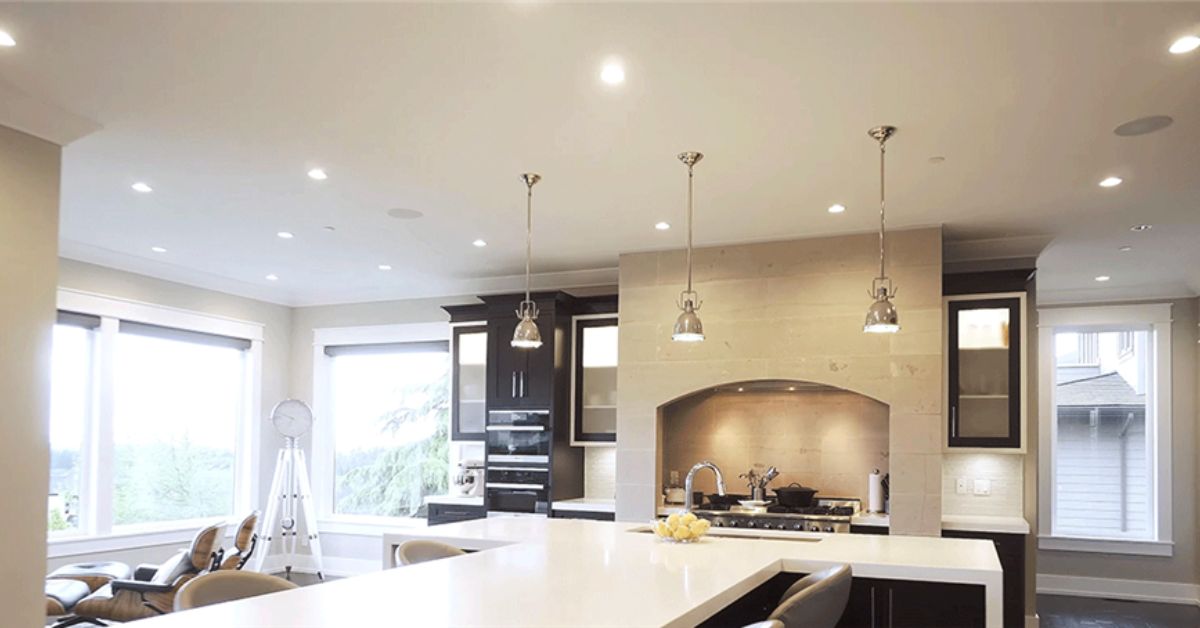
Why choose LED Kitchen Lights in Delhi?
LEDs have become the default for modern kitchens for good reasons: efficiency, longevity, reduced heat output, and flexibility in fixture design. For kitchens in Delhi specifically, durability against dust and humidity, and fixtures that don’t add unnecessary heat during long, hot summers, are important considerations.
Compared with older technologies, LEDs deliver:
- Higher lumen output per watt, so smaller fixtures can produce enough light.
- Long lifespans — many LEDs reach 30,000–50,000 hours with decent lumen maintenance.
- Lower heat at the fixture itself, which helps keep the kitchen more comfortable in summer.
- Better dimming and color control, so you can set a bright task light for cooking and soft ambient light for evenings.
When you evaluate products in showrooms or online, focus on measurable specs (lumens, CCT, CRI) rather than only on wattage or brand imagery.
Types of LED fixtures you’ll use in a kitchen
A well-lit kitchen uses several fixture types working together. Mix and match these for the best result.
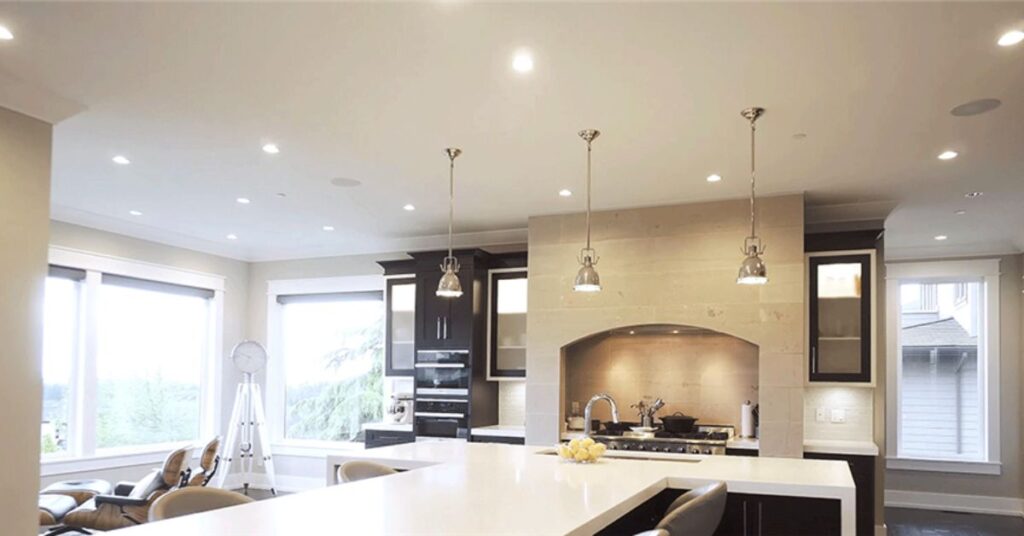
- Recessed downlights/downlighters — clean look, great for general ambient lighting. Use multiple fixtures spaced for even coverage.
- LED panel lights / ceiling-mounted fixtures — useful for flats or where a continuous, diffuse ambient light is preferred.
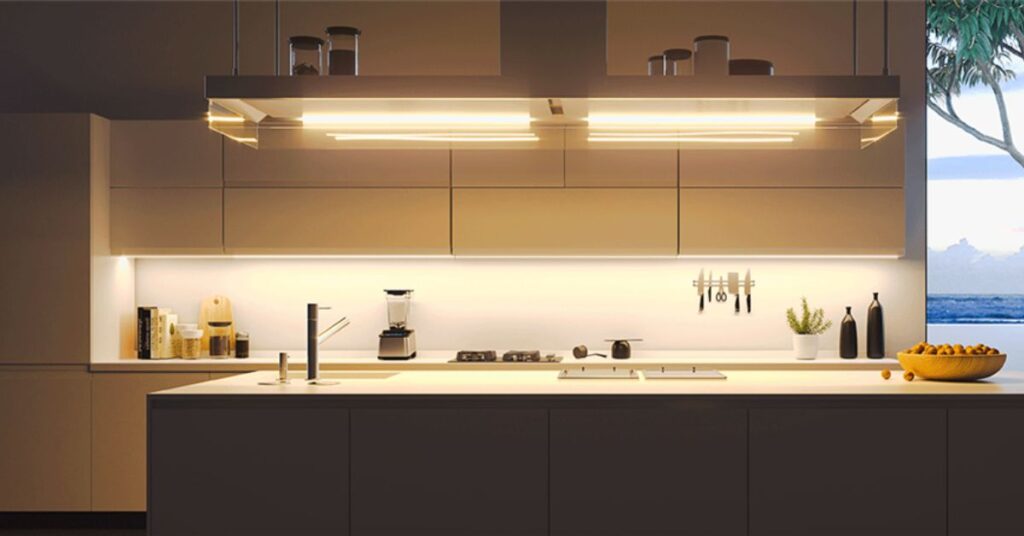
- Under-cabinet LED strips or puck lights — essential for task lighting on countertops. Look for low-glare diffusers.
- Pendant lights — decorative and functional over islands or dining counters. Choose pendants with good downlight and well-controlled glare.
- Track lighting — a flexible option for directing light to work zones or accenting surfaces.
- Integrated LED modules in cabinets and shelves — neat for display zones and inside cupboards.
- Emergency and exhaust-compatible fixtures — for kitchens with heavy cooking, consider IP-rated fixtures or those designed to be near range hoods.
Choosing the right combination creates layered lighting: ambient + task + accent. Layering is the practical secret behind kitchens that are both highly usable and visually pleasing.
Key product specifications every buyer must demand
When comparing models, ask vendors for these specs — they determine how a fixture performs in real life.
Lumens (total light output)
Lumens tell you how much usable light a fixture produces. For kitchens, specify lumens per fixture rather than relying on wattage.
Lumens per watt (lm/W)
This is efficiency. Higher lm/W translates to lower energy costs.
Color temperature (CCT)
Measured in Kelvin:
- 2700–3000 K — warm, cozy, often used for ambient lighting.
- 3000–3500 K — neutral-warm, flattering for food and people.
- 4000–5000 K — cool/neutral, ideal for precise tasks and crisp color rendering.
For worktops and food prep, 3000–4000 K is a common choice; 4000 K helps with clarity when cutting and reading labels.
Color Rendering Index (CRI)
CRI measures how accurately a light source shows colors. For kitchens, aim for CRI 80+, and CRI 90+ if you want excellent food and material rendering (especially useful for chefs or culinary displays).
Beam angle & optics
Tight beams for pendant/task lights; wide beams for ambient fixtures. Under-cabinet strips usually have wide, even optics to avoid hotspots.
Dimmability & driver quality
Look for flicker-free drivers and clear dimming compatibility (TRIAC, 0–10V, or DALI, depending on control system). Poor drivers cause flicker and early failures.
IP rating (where applicable)
For fixtures near sinks, windows, or open-to-sky balconies, consider IP44+ protection to guard against splashes and humidity.
Warranty & Lumen maintenance (L70/L80)
L70 indicates the time until the light output falls to 70% of its initial. A 30,000–50,000-hour L70 is typical for quality fixtures. Look for at least a 2–5 year warranty on the fixture and driver.
Flicker and EMI
For camera use or video content creation, check for low flicker ratings and minimal electromagnetic interference.
Layout planning & target lux levels
Plan the layout before buying; a sketch is immensely helpful for installers. Typical lux targets for kitchen zones:
- General ambient (ceiling): 150–300 lux
- Countertops & prep zones (task): 300–750 lux (aim higher where detailed chopping or measurements happen)
- Sink & hob areas: 300–500 lux, with glare-controlled lighting to avoid reflections on stainless surfaces
- Island workspace: 300–600 lux, often achieved with pendant clusters + ambient lighting
- Cabinet interiors & display shelves: 100–300 lux for visibility and mood
Use these targets to compute how many fixtures you need. For example, if a downlight delivers 900 lumens and your 10 m² kitchen needs an average of 300 lux (i.e., 3,000 lumens total), you’ll need around four such fixtures for even ambient coverage — plus dedicated task lights.
Photometric planning (using IES files) helps in bigger projects or when you need very precise uniformity. For a typical home kitchen in Delhi, a well-thought-out fixture schedule with lumen counts usually suffices.
Product recommendations & practical picks
Below are product-focused suggestions mapped to common kitchen needs.
1. Recessed downlights (for ambient)
- Choose 80–120 mm downlights with 800–1,600 lumens each, CCT 3000–4000 K, CRI ≥80.
- Look for integrated LED modules with replaceable drivers and good thermal sinks for longevity.
2. Under-cabinet strips/puck lights (for task light)
- Opt for 300–800 lm/m LED strips with frosted diffusers for even light.
- Low-profile linear fixtures with 120° optics reduce shadowing.
- Look for 12V or 24V DC LED drivers; many require a small transformer — ensure space inside cabinets.
3. Pendant lights (over islands)
- Choose pendants with focused downward light and minimal glare. A cluster of 2–3 pendants, each 300–800 lumens, is common.
- Use dimmable drivers and a heavier gauge suspension if you plan to adjust height frequently.
4. Track lighting (for flexible accent & task)
- Use LED track heads with adjustable beam angles (15–60°) and high CRI for display areas. Track systems allow rearranging without rewiring.
5. Integrated task fixtures & cabinet interiors
- Small LED modules inside cabinets and pantry shelves help with quick access. Magnetic or clip-on fixtures make replacements easy.
6. Outdoor/utility zones
- For balconies or external kitchen extensions, choose IP65-rated fittings.
When you’re in showrooms in Delhi, ask to see samples in a mockup or at least at home using portable samples — colors and output look different on-site.
Controls, smart features & convenience
Controls let you adapt lighting for different activities and save energy:
- Dimmers — Essential for ambient control and mood. Use compatible dimmable fixtures and confirm the dimmer type.
- Zoning — Put task and ambient circuits on separate switches so you only light what you need.
- Motion sensors — Useful for pantry or utility cupboards; avoid them for main prep zones where constant presence is common.
- Timers & scenes — Program “cooking” scene with brighter task lighting and “dinner” scene with warmer, dimmer ambient light.
- Smart lighting — Wireless platforms (Bluetooth Mesh, Zigbee, Wi-Fi) let you control scenes from phones and integrate with assistants (Alexa/Google). For Delhi buyers, choose systems with reliable offline control (local hub) to avoid internet dependency.
If you plan a full smart retrofit, define the control protocol early because driver compatibility matters for dimming quality.
Energy use, running cost & ROI
LEDs drastically lower energy bills compared to halogen or CFL setups. Quick example for Delhi buyers:
- A typical 10-fixture LED kitchen (each ~10–15 W for downlights) running 4 hours/day equals ~0.5–0.6 kWh/day → ≈15–18 kWh/month. At a common residential tariff (check current rates), that’s modest compared to older lighting systems, where each fixture might have been 50–75 W.
To estimate ROI, include:
- Fixture cost (including installation)
- Electricity savings vs. previous lights
- Reduced lamp replacement and maintenance costs
- Any government or utility rebates (occasionally available for energy-efficient fixtures)
In many cases, LED fixtures pay back through lower bills and maintenance savings within a couple of years for residential kitchens.
Installation, wiring & safety considerations
- Use a licensed electrician who follows local wiring regulations. Kitchens are wet zones; ensure proper earthing and RCD protection for circuits.
- Use separate circuits for heavy appliances and lighting to avoid nuisance tripping.
- Ensure drivers are installed in ventilated enclosures, not cramped inside non-ventilated cabinets where heat shortens life.
- Position lights to avoid direct glare in the cook’s eyes and reflections on glossy surfaces. Aim beams to illuminate worktops instead of bouncing off stainless steel.
- For fixtures near hobs, maintain a safe offset from cooking fumes and heat; some high-heat zones need special-rated fixtures.
A professional installation protects your warranty and minimizes future trouble.
Maintenance & longevity
- Clean diffuser lenses every 3–6 months to remove dust and grease — Delhi’s environment can cause quicker build-up.
- Check driver housings and seals after the monsoon season to spot moisture ingress.
- Replace drivers (not entire fixtures) where possible — many modern LEDs allow driver replacement.
- Keep spare bulbs/drivers for critical fixtures over islands or above the sink to reduce downtime.
A small maintenance plan extends fixture life and maintains consistent light levels in your kitchen.
Buying options in Delhi
When shopping for LED kitchen lighting in Delhi, you can choose between local showrooms, authorised dealers, and e-commerce. Best practice:
- Visit showrooms to compare actual light output and color. Pictures lie — see the light in person.
- Request datasheets and IES files for professional installations to model lighting.
- Ask about warranty fulfilment in Delhi and local service partners.
- Get installation quotes from certified electricians and include commissioning in the contract.
- Buy from established brands or authorised dealers who provide driver and module spares locally.
If you plan a full kitchen renovation, ordering sample fixtures and testing them in situ before final purchase helps avoid surprises.
Printable checklist for buyers
- Desired CCT and CRI defined (e.g., 3000 K, CRI 90)
- Target lux levels for worktops and islands specified
- Fixture schedule with lumen outputs per zone prepared
- Dimming & controls strategy decided (dimmers, zones, smart hub)
- IP rating check for wet/exposed areas (IP44+)
- Driver type and dimmer compatibility confirmed
- Warranty and local service network verified in Delhi
- Installation and commissioning quote included in the purchase order
Use this checklist when visiting showrooms or briefing contractors.
Frequently Asked Questions (FAQ)
Q: What CCT works best for food prep?
A: 3000–4000 K gives a balance of warmth and clarity; 4000 K is clearer for precise tasks.
Q: How many lumens do I need over a 2-meter worktop?
A: Aim for 300–500 lux — calculate total lumens required by multiplying area by target lux and dividing by fixture efficiency, and number of fixtures.
Q: Are LED strips safe near a gas hob?
A: Use IP-rated fixtures and keep them clear of direct heat or steam. Ensure strips are installed where they won’t be exposed to grease and high temperatures.
Q: Should I use warm or cool pendants over the island?
A: Warm (3000 K) is cozy for dining; neutral (3500–4000 K) works better if the island is mainly for food prep.
Conclusion
Choosing the right LED Kitchen Lights in Delhi means balancing performance, energy use, durability, and aesthetics. Focus on measurable specs — lumens, CRI, CCT, lm/W, and driver quality — and plan your layout around task zones. Use under-cabinet strips for clear countertops, recessed or panel ambient fixtures for uniform light, and pendants or track heads for character and task focus. Insist on proper installation, local warranty support, and a small maintenance plan to keep your kitchen bright and welcoming for years.