
Who this guide is for and what you’ll get
If you’re shopping for Commercial Lighting in Delhi, this guide is written for you — whether you’re a facility manager, an architect, a retail owner, or a contractor. This article explains what matters beyond the product brochure: which fixtures suit which spaces, how to read technical specs, how lighting impacts productivity and safety, how to calculate running cost and return on investment, and practical procurement and installation tips tailored to Delhi’s climate and commercial context.
By the time you finish, you’ll have a clear step-by-step process to specify, compare, and buy the right commercial lighting products for your project in Delhi — and avoid the common mistakes that waste money and time.
Why good commercial lighting matters
Good Commercial Lighting in Delhi does more than make a space visible. It:
- Improves worker productivity and accuracy by providing the right light levels and color rendering.
- Enhances retail sales by making products look attractive and inviting.
- Reduces operational costs through energy-efficient LEDs and smart controls.
- Increases safety and security in parking, logistics, and manufacturing zones.
- Supports brand identity in hospitality and corporate spaces through layered lighting design.
Delhi’s climate — hot summers, dusty conditions, and a pronounced monsoon season — means you should prioritize durable fixtures with suitable IP ratings and easy-to-clean housings. Choosing the right commercial lighting reduces replacements and maintenance calls, which is essential in busy Indian commercial environments.
Types of commercial fixtures and where to use them
Here’s a product-oriented breakdown of common fixtures used in Commercial Lighting in Delhi, and practical notes on selection.
- LED Panel Lights / Troffers — Used in offices, conference rooms, and retail ceilings. Choose high CRI (≥80) and >100 lm/W efficiency for good results. Slim, recessed panels offer clean aesthetics and even light distribution.
- High Bay & Low Bay Lights — Designed for warehouses, factories, and showrooms with high ceilings. High bays (12m and above) require focused optics and high lumen outputs; Low bays (6–12m) use wider beam angles. Look for models with good thermal management to preserve lumen output.
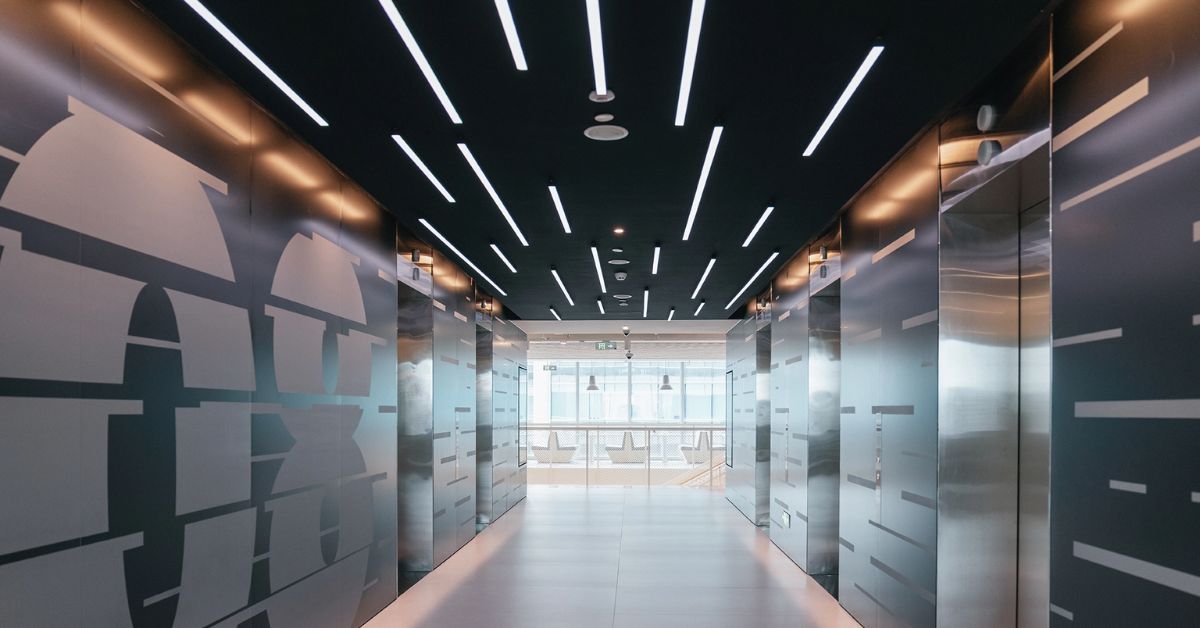
- Linear Architectural Lights — For corridors, retail aisles, and modern office layouts. They’re excellent for continuous runs and accenting shelves. Modular options make maintenance easier.
- Downlights & Spotlights — For task lighting and accenting displays in showrooms and hospitality. Look for adjustable trims and high CRI for accurate color rendering.
- Floodlights & Wall Washers — For façade lighting, loading bays, and outdoor areas. Use high IP and IK rated fixtures. For façade work, consider tunable white or RGBW options for brand-centric illumination.
- Emergency & Exit Lighting — Must be compliant with local safety codes and offer battery backup rated for the required autonomy (commonly 1–3 hours).
- Street & Carpark Lights — For external circulation and parking; choose optics that control glare and minimize light spill.
- Track Lighting & Retail Spot Systems — Give flexibility in merchandising; choose dimmable drivers and adjustable heads.
When planning Commercial Lighting in Delhi, pick fixtures that balance lumen output, energy efficiency, longevity, and easy serviceability.
Key specifications every buyer must demand
A spec sheet can look intimidating. Focus on these core attributes for Commercial Lighting in Delhi purchases:
- Lumens (not watts) — Lumens measure light output. Specify target lux levels for each space (office desk, retail shelf, warehouse aisle) and select fixtures whose lumen output meets those targets when accounting for mounting height and beam angle.
- Lumen per Watt (lm/W) — Shows efficiency. Modern commercial LEDs commonly deliver 100–160 lm/W. Higher lm/W reduces energy bills.
- Color Temperature (CCT) — Expressed in Kelvin. Typical recommendations:
- Office: 3500–4000 K (neutral)
- Retail: 3000–4000 K depending on product type
- Warehouse: 4000–5000 K for clarity
- Hospitality: layered approach with warm accent lights (2700–3000 K)
- CRI (Color Rendering Index) — CRI ≥80 is acceptable for general commercial use; CRI ≥90 is preferred for retail, galleries, and hospitality where color fidelity matters.
- Beam Angle & Optics — Determines coverage. Narrow optics for high shelves or displays; wide optics for general area wash.
- IP & IK Ratings — For outdoor and industrial environments, choose IP65 or higher. IK07–IK10 for vandal-prone or heavy-duty zones.
- Driver Quality & Dimming Protocols — Look for drivers with THD <20%, surge protection, and compatibility with DALI, 0–10V, or wireless controls like Casambi if you plan smart integration.
- Warranty & L70/L80 Life Ratings — Ask for L70 figures (hours until lumen output reaches 70% of initial). A 50,000-hour L70 is common for reliable commercial products.
- Safety & Compliance — Request product certification documentation (BIS or equivalent) and ROHS/CE component compliance where applicable.
Insist vendors include a technical datasheet with these metrics — it’s the essential tool to compare offers when procuring Commercial Lighting in Delhi.
Space-by-space recommendations and lumen targets
Below are practical, product-oriented recommendations for common Delhi commercial spaces. These are starting points — final numbers depend on layout and activity.
- Open-plan offices: 300–500 lux on work surfaces. Use LED panel lights or linear continuous lighting with 3500–4000 K, CRI 80–90. Task lighting at desks improves comfort.
- Conference rooms: 300–400 lux with dimmable options for presentations. Combine recessed downlights with indirect cove lighting.
- Retail & Showrooms: 500–1000 lux on merchandise, higher on jewelry/fgoods. Use spotlights for focal items (CRI 90+ for accurate colors) and linear fixtures for aisles. Consider accent lighting and adjustable track systems.
- Warehouses / Logistics: 150–300 lux in aisles; higher for packing stations. Use high bay LED fixtures with narrow optics for tall racking. Choose robust thermal management for continuous operation.
- Restaurants & Hospitality: Layered lighting — ambient 150–300 lux, table/task 300–500 lux. Warm CCT (2700–3000 K) fosters comfort; use accent lighting for décor.
- Parking & External Areas: 10–30 lux for general circulation, 50 lux at pedestrian crossings and entrances. Use floodlights with controlled optics and high IP/IK protection.
- Healthcare & Labs: Task-specific lux levels; strict CRI and flicker requirements. Procure medical-grade luminaires and check for flicker-free drivers.
For every space, create a short “fixture schedule” listing fixture type, lumen output, CCT, mounting height, and control strategy — this becomes your procurement spec for Commercial Lighting in Delhi.
Controls, automation, and smart lighting
Smart controls are where you capture most energy savings in modern Commercial Lighting in Delhi projects:
- Basic controls: Timers and photocells reduce unnecessary runtime. Ideal for exteriors and parking.
- Occupancy sensors: PIR or microwave sensors in meeting rooms, toilets, and storerooms. They prevent lights from being left on for long idle periods.
- Daylight harvesting: Dimming fixtures based on available natural light (saves energy in perimeter zones).
- Networked systems (DALI, BACnet, KNX): Allow centralized control, scheduling, zone-level metering, and integration with building management systems. Recommended for medium to large commercial buildings.
- Wireless mesh controls (Casambi, Bluetooth, Zigbee): Easier retrofits with lower cabling cost and good scalability for offices and retail.
- Lighting analytics: Some advanced systems provide usage reports and predictive maintenance alerts — valuable in large multi-site operations.
When buying Commercial Lighting in Delhi, match the control complexity to your needs: simple occupancy sensors for small shops; networked controls for campuses and malls to maximize savings and operational visibility.
Procurement: showrooms, distributors, and online marketplaces
Where to buy depends on scale:
- Showrooms & Authorized Dealers: Best for small projects and for physically inspecting fixtures and beam patterns. Ask for demo comparisons and request photometric files (IES files) to simulate lighting if needed.
- Distributors & Wholesalers: Good for bulk purchases; they can provide project-level support, faster warranty service, and spare parts.
- E-commerce & Marketplaces: Convenient for standardized fixtures, but verify warranty fulfillment and seller credibility. Keep technical datasheets and invoices for compliance.
- Lighting Designers & Specifiers: For high-stakes hospitality, corporate HQs, or branded retail stores, hire a lighting designer to create a specification and lighting control sequence.
When sourcing Commercial Lighting in Delhi, request sample fixtures (or night-time demos where possible), ask for IES/LM-63 files for photometric planning, and work with vendors that provide installation and after-sales support.
Installation, commissioning, and maintenance
A good product can fail in the field due to poor installation. Follow this checklist for Commercial Lighting in Delhi projects:
- Use certified electricians and contractors familiar with outdoor conduit standards and IP-rated junctions.
- Ensure proper thermal clearance around fixtures; many LED failures start from overheating.
- Commission controls and dimming curves; verify that sensors aren’t falsely triggered.
- Record as-built fixture locations, circuiting, and control addressing for later troubleshooting.
- Plan periodic maintenance: cleaning fixture lenses (Delhi’s dust reduces output), checking seals after monsoon, and driver health checks.
- Keep spare drivers and LED modules for critical areas to avoid long downtimes.
Include commissioning reports and warranty activation documents in project closeout — it saves headaches later.
Buying checklist
- Use-case & lux targets defined for every zone
- Fixture schedule with lumens, CCT, CRI, beam angle, IP/IK, and driver specs
- Photometric files (IES) requested for key areas
- Control strategy specified (sensors, DALI/0–10V or wireless)
- Warranty details and spare-part availability confirmed
- Installation & commissioning scope documented
- Energy & ROI calculation included in purchase justification
- Vendor references and on-site demo or sample inspection completed
This checklist will help you evaluate suppliers and secure reliable Commercial Lighting in Delhi products.
Common pitfalls and red flags
- Vendors who quote only wattage without lumen output.
- No photometric data or IES files for area planning.
- Missing IP/IK ratings for outdoor/industrial fixtures.
- Short warranties or unclear warranty fulfillment in India.
- Low-cost imports without service partners — short-lived savings.
Avoid these when specifying Commercial Lighting in Delhi.
Frequently Asked Questions (FAQ)
Q: How many lumens do I need for an office?
A: Aim for 300–500 lux on desks; calculate using fixture lumen output, room geometry, and mounting height.
Q: What CCT should I choose for retail?
A: 3000–4000 K depending on product type; use higher CRI (≥90) for textiles, food, and color-critical merchandise.
Q: Are smart controls worth the investment for small shops?
A: For single small shops, simple timers and occupancy sensors may be sufficient. For multi-store or malls, networked controls provide operational savings and analytics.
Q: How important is driver quality?
A: Critical. Driver failures account for many premature luminaire retirements. Choose vendors offering robust drivers with surge protection and thermal safeguards.
If you want personalized fixture schedules for your project in Delhi, I can help prepare a room-by-room spec and a short vendor comparison template.
Final thoughts
Specifying Commercial Lighting in Delhi requires a balance of design intent, technical performance, and practical procurement. Prioritize real performance numbers (lumens, lm/W, CCT, CRI, IP/IK, driver specs), insist on photometric files and warranties, and plan for controls to realize long-term savings. With the right approach, lighting becomes an asset — saving energy, improving worker comfort, elevating brand experience, and lowering total cost of ownership.