
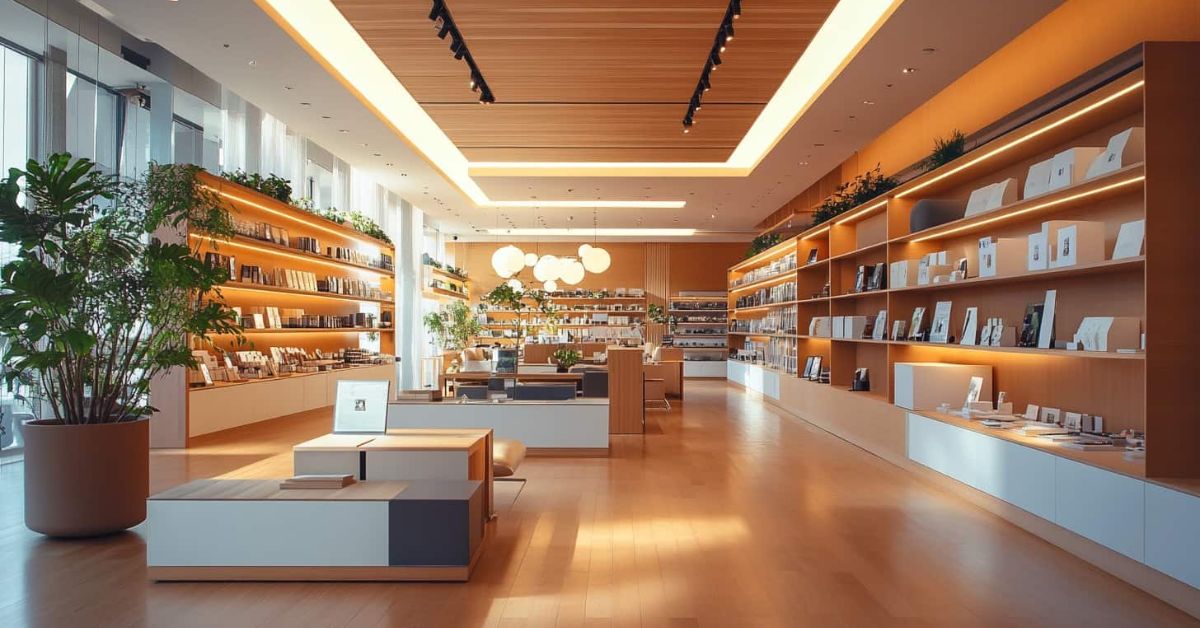
Why visit a commercial lighting showroom in Delhi
If you’re specifying lighting for an office, retail space, hotel, warehouse, or public building, a commercial lighting showroom in Delhi is where conceptual planning meets practical reality. Commercial lighting differs from residential lighting in scale, compliance requirements, control systems, and long-term energy costs — and the right showroom will help you match fixtures, drivers, and controls to performance targets and budgets. This guide covers everything a new buyer needs to know: what to expect at a commercial lighting showroom in Delhi, product families and their use-cases, technical specs to demand, sourcing and budgeting, installation considerations, and where to begin your search in the city.
What a commercial lighting showroom in Delhi should offer
A serious commercial lighting showroom in Delhi should provide:
- Working demo areas showing panels, high bays, linear systems, track & accent lighting, and floodlighting.
- Detailed datasheets (lm, lm/W, CCT, CRI, IP, beam angle, driver specs).
- Lighting design support — basic lux calculations or photometric layouts for your space.
- Options for controls: DALI, 0–10V, DMX, Zigbee, or proprietary systems.
- Warranty & spares information, plus service support for drivers and modules.
- Project procurement capability (bulk ordering, phased delivery).
If a showroom can’t produce datasheets or control options on request, look elsewhere — commercial projects demand documented performance.
Who visits a commercial lighting showroom in Delhi
Buyers include:
- Electrical contractors and MEP consultants are sourcing fixtures and drivers.
- Interior designers and architects specify appearance and lighting scenes.
- Facilities managers for offices, retail chains, hotels, and hospitals.
- Project managers are procuring bulk lighting kits for new builds or retrofits.
- Retail store owners and franchise operators need consistent fixtures across multiple outlets.
Showrooms that serve these groups usually stock both ready-made commercial luminaires and project-grade systems, and can scale their services from single-store rollouts to multi-site deployments.
Product families you’ll find at a commercial lighting showroom in Delhi
A commercial lighting showroom in Delhi will offer products categorized by application. Here’s a buyer-oriented breakdown:
1. LED Panel Lights & Ceiling Systems
Used in offices, classrooms, and corridors. Choose panels with uniform illumination, high efficacy (lm/W), and options for tunable white if human-centric lighting is required.
2. Recessed & Surface Downlights
For retail and hospitality, where accenting and precise beam control matter. Pick spot optics with narrow beam angles for product highlighting and wide-beam trims for general lighting.
3. Linear Architectural Systems
Modular linear luminaires for offices, retail aisles, reception counters, and feature lines. They’re ideal for continuous runs and create clean, modern lines.
4. High Bays & Low Bays
For warehouses, factories, and big-box retail. Prioritize high lumen output, robust optics, and good thermal design to maintain lumen maintenance over time.
5. Floodlights & Area Lighting
For external facades, car parks, and sports lighting. Look for selectable optics and IP66+ ratings for exposed conditions.
6. Emergency & Exit Lighting
Essential for compliance; choose self-contained or central-battery systems based on building codes.
7. Track Systems & Accent Lighting
Flexible systems for shops and galleries to direct light where merchandising or art needs accenting.
8. Linear LED Strips & Profiles
For cove, under-shelf, and architectural accenting. Choose SMD type, IP rating, and compatible drivers/controllers.
9. Controls, Drivers & Sensors
Commercial projects often specify DALI, 0–10V, or networked lighting control systems; reliable drivers and surge protection are non-negotiable.
A capable commercial lighting showroom in Delhi will be able to show working versions of most of these families and explain trade-offs for your project.
Key technical specs every buyer must demand (and how to read them)
When you visit a commercial lighting showroom in Delhi, get datasheets and insist on explanations for these specs:
- Lumens (lm): Real light output. Compare required lumens for task levels (e.g., office ambient vs retail display).
- Efficacy (lm/W): Efficiency — higher lm/W = lower operating cost. Commercial fixtures often target 100 lm/W+ for panels and 120 lm/W+ for high-bay solutions.
- CCT (Kelvin): 3000–4000K common for offices/retail; tunable white may be required for hospitality or healthcare projects.
- CRI (Ra): Aim for CRI ≥ 80 for general spaces; CRI ≥ 90 for retail and color-critical tasks.
- Lumen Maintenance (L70/L80): Indicates expected light retention over time; get L70 or L80 figures and LM-80 test data if available.
- Beam Angle & Optics: Choose narrow beams for product accenting and wider beams for general illumination. Ask to see beam patterns.
- IP Rating & IK (Impact) Rating: For outdoor or industrial areas; e.g., IP65+ for exposed fixtures, IK08+ for vandal-prone zones.
- Driver Quality & Surge Protection: Commercial sites should use drivers with surge protection and thermal protection; ask brand/model.
- Dimming & Control Protocols: Verify compatibility with planned control systems (DALI, 0–10V, DMX, or wireless).
- Certifications & Compliance: Check BIS/IS, CE, or manufacturer test reports where relevant for public/commercial buildings.
Datasheets are non-negotiable for commercial projects — they form the basis for tenders, energy models, and warranty claims.
Lighting design basics for commercial spaces
Before you buy, clarify the lighting goals: task performance, energy efficiency, merchandising, or ambiance. At the showroom, ask them to:
- Provide a simple lux plan or rule-of-thumb (lux targets for offices ~300–500 lx for workspaces, retail depends on design).
- Recommend fixture spacing, mounting height, and beam control.
- Suggest control strategies (occupancy sensors, daylight harvesting, scheduling).
- Recommend driver types and surge protection levels suitable for your building.
- Outline maintenance and cleaning requirements for chosen fixtures.
Good showrooms can produce a preliminary layout or direct you to a lighting designer/consultant for full photometrics.
Where to source commercial lighting in Delhi — showrooms, wholesalers, and clusters
Delhi offers both curated commercial showrooms and heavy-trade clusters for bulk procurement. Use the type of vendor that matches your project:
- Specialized commercial lighting showrooms — Best for performance luminaires, design consultations, and control demos. They serve architects, designers, and facility managers and often carry international and certified products.
- Wholesalers & trade clusters (Bhagirath Palace, Chandni Chowk, Rajouri Garden) — Useful for project-scale buys and fast availability of LED panels, drivers, and bulk items. Bhagirath Palace is a long-established wholesale market for lighting and decorative fixtures.
- Large brand showrooms & dealer networks — National brands and multi-city suppliers offer LEDs, controls, and warranty support across India; they’re a good choice for standardized, tested products. Listings of commercial lighting dealers and distributors are available in local directories that aggregate options across Delhi.
If you plan bulk procurement, visit both specialized showrooms for spec selection and wholesalers for competitive pricing and availability.
Notable Delhi lighting clusters and examples to check
Many commercial buyers still source from well-known Delhi hubs. Bhagirath Palace remains a major wholesale destination for electrical and lighting products and is frequently cited as a go-to market for bulk buying and last-minute procurement, especially ahead of seasonal demand.
Rajouri Garden and market pockets like Lajpat Nagar also host many lighting dealers where you can see LED panels, decorative ranges, and sample installations before committing to larger orders. For project-grade suppliers with an organized catalog and trade support, look for established distributors serving commercial projects.
Controls, automation, and energy management (what showrooms should demo)
Controls are central to commercial lighting performance. A commercial lighting showroom in Delhi should demo:
- DALI-controlled fixtures and central management systems for scene-setting and monitoring.
- Occupancy sensors and daylight-harvesting setups for energy savings.
- Networked lighting management for multi-floor monitoring and scheduling.
- Emergency integration to ensure life-safety loads override normal controls when needed.
Ask for a demo that shows commissioning, app or desktop dashboards, and how schedules/scenes are set. Control compatibility is crucial — the showroom should confirm the fixtures and drivers you choose will integrate with your chosen control ecosystem.
Procurement tips: tendering, samples, and testing
For larger commercial projects:
- Request product samples and test them in situ where possible (see color, glare, and beam).
- Ask for photometric files (IES/LM-79) when specifying illuminance across areas.
- Specify driver part numbers and make, and require them in the bill of materials.
- Ask for warranty certificates and spare-part lead times in the tender.
- Consider staged delivery and a mock-up room approval process before mass installation.
A reputable commercial lighting showroom in Delhi will support sampling, mock-up approvals, and provide the documentation you need for procurement and building compliance.
Installation and electrical compliance considerations
Commercial installations require professional handling:
- Comply with local electrical codes and fire-safety rules. Confirm whether the fixtures need specific approvals for emergency systems.
- Use licensed electricians and test all installations for earth continuity and surge protection.
- Waterproofing and ingress protection for external and exposed fixtures (car parks, facades) must be verified.
- Commission the control system and retain commissioning reports (DALI addressing, system configuration).
- Keep a spare driver stock and a maintenance plan; drivers are the most common point of failure.
Ask your showroom for certified installers or references they’ve worked with on Delhi projects.
Warranties, spares, and after-sales support
For commercial projects, warranties and spares are critical:
- Separate warranties: LED module, driver, and fixture finish may have separate warranty terms — get this in writing.
- Response time for failures: Ask how quickly they can replace DOA or failed units in Delhi.
- Spare stock: Ensure drivers and LED modules are available locally or can be delivered quickly.
- Service contracts: For large sites, ask about preventive maintenance contracts and annual checks.
A showroom’s willingness to promise and deliver post-sale support is as important as the product spec itself.
Common mistakes buyers make
- Buying on appearance alone — always demand datasheets and photometrics.
- Ignoring driver specs — cheap drivers shorten LED life; insist on branded drivers with surge protection.
- Overlooking controls compatibility — test dimming and control scenes before committing.
- Underestimating maintenance — plan for lens cleaning, seal checks, and driver spares.
- Not proofing for local conditions — Delhi’s dust, heat, and occasional heavy rain demand good IP and thermal design.
A well-prepared visit to a commercial lighting showroom in Delhi prevents these errors.
How to choose the right showroom for your project
Use this decision checklist to pick a commercial lighting showroom in Delhi:
- Can they provide LM-79/IES files and LM-80/Lumen maintenance data?
- Do they demo controls (DALI, 0–10V, wireless) and provide commissioning support?
- Do they have references for similar Delhi projects?
- Are spare parts and drivers available with short lead times?
- Do they offer mock-up approvals or sample testing?
- Is there a clear warranty policy and quick on-ground support?
If the showroom can’t answer these, escalate to another supplier.
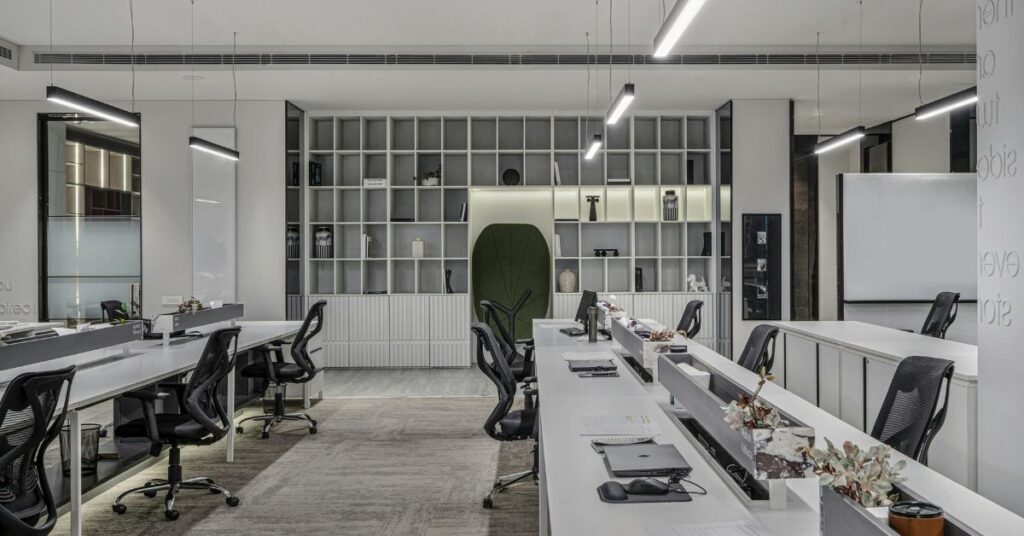
Where to begin — practical next steps
- Assemble basic project data: floor plans, ceiling heights, target lux levels, and budget.
- Shortlist two types of vendors: a specialized commercial lighting showroom for spec selection, and a wholesaler for bulk supply and spares. (Local directories list commercial lighting dealers and distributors across Delhi.)
- Visit showrooms with your brief; request datasheets, control demos, and a simple lighting layout proposal.
- Get written quotes that separate fixture cost, drivers, controls, installation, and commissioning.
- Arrange a mock-up or sample test in situ before full procurement.
If you’d like, I can draft a short RFQ email you can send to shortlisted showrooms in Delhi requesting datasheets, IES files, and a sample/mock-up visit.
Final checklist — what to collect at the showroom
- Model numbers and full datasheets (lm, lm/W, CCT, CRI, IP, beam).
- Driver part numbers and dimming/control protocol details.
- IES/LM-79 photometric files for selected fixtures.
- Warranty statements and spare part lead times.
- Installation, commissioning, and maintenance quotes.
- References for past Delhi commercial projects.
Take this checklist to each commercial lighting showroom in Delhi you visit and compare notes.
Conclusion — buying with confidence
Specifying lighting for commercial spaces is a technical and procurement challenge, but the right commercial lighting showroom in Delhi transforms risk into predictable performance. Insist on datasheets, control compatibility, mock-up testing, and clear warranty terms. Visit both specialized showrooms for spec and aesthetics, and wholesale clusters for competitive pricing and spare parts. With a clear brief and the documentation suggested in this guide, you’ll be able to evaluate suppliers, compare TCOs, and choose a partner who will support your project from mock-up to long-term maintenance.